
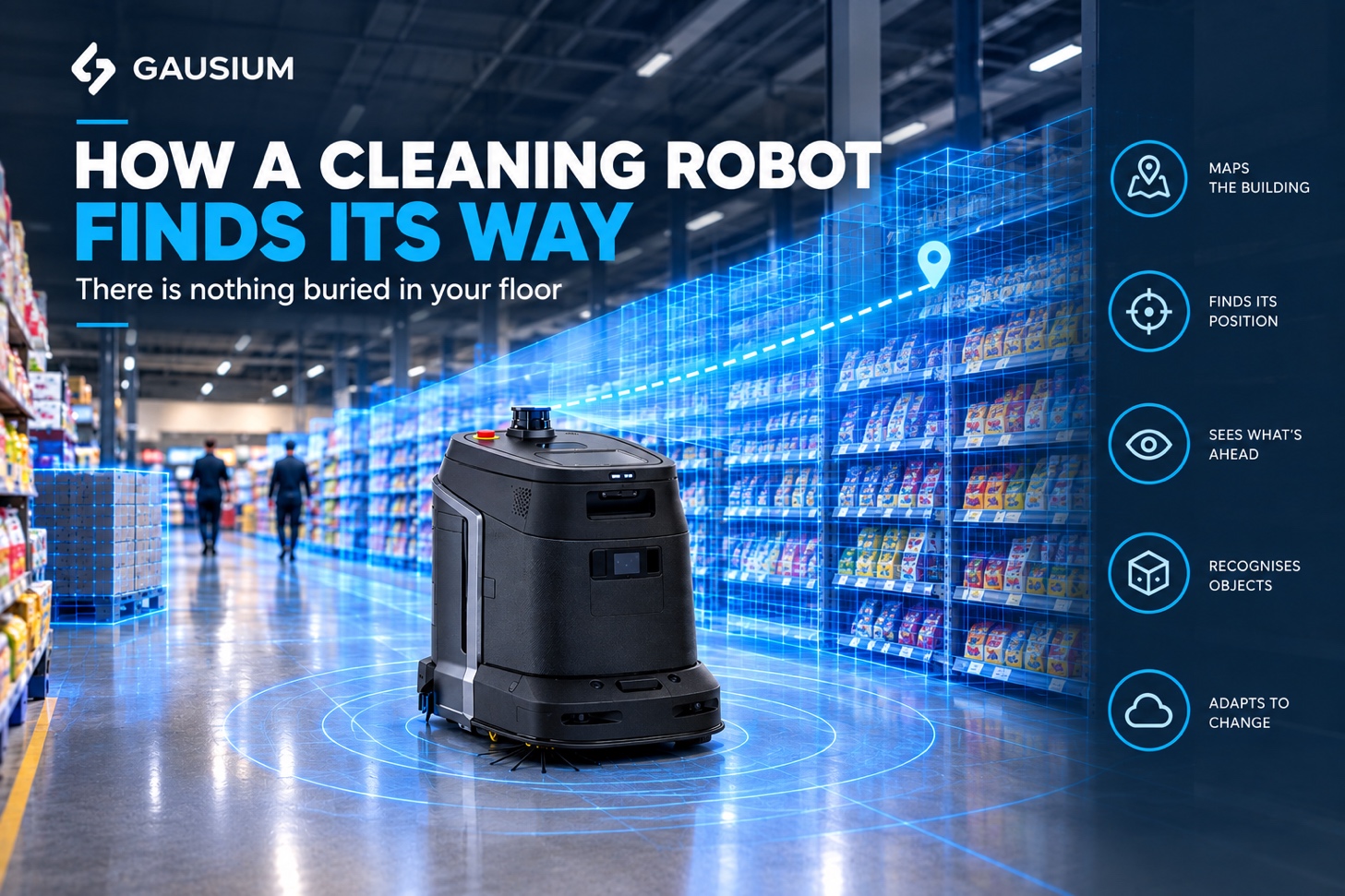
Watch one of these machines work for a few minutes and you end up asking the same question everyone asks. How does it know where to go?
A surprising number of people assume there’s something in the floor. Buried wire, magnetic tape, a track of some kind. That guess isn’t silly, because that is exactly how the old warehouse machines worked, and the idea has stuck around long after the technology moved on.
Nothing goes into your floor. The robot builds its own picture of the building, and then works out, over and over, where it is standing inside that picture.
First it draws the place
On its first visit the machine has to learn the site. It sweeps a laser around itself, hundreds of thousands of measurements a second, timing how long the light takes to bounce back off whatever it hits. Walls here. A column there. Shelving running that way. Out of all those distances it assembles a shape of the building.
The tricky bit is that it’s solving two problems at once, and each one needs the answer to the other. To put a wall in the right place on the map, it has to know where it was standing when it saw that wall. To know where it’s standing, it needs a map. Roboticists call this SLAM, short for simultaneous localisation and mapping, which sounds harder than it feels. You do it yourself whenever you wake up in an unfamiliar hotel room at 2am and go looking for the bathroom. Same information, both jobs, at the same time.
Older machines needed someone to drive them around the site to teach the route. Gausium’s newer models will explore and map a building on their own, without a floor plan and without an engineer walking behind them.
Then it has to find itself again
Drawing the map happens once. The job that runs every single night is working out where on that map the machine currently sits.
It does this by comparing what it can see right now against what it remembers. The shape of this corner, the spacing of those columns, the run of that wall. Enough of it lines up and the robot knows where it is to within a few centimetres, then sets off on its route.
You do the same thing walking into your own kitchen in the dark. You don’t measure anything. The shape of the room tells you where you are.
One detail matters more than it sounds for a machine that works overnight: the laser doesn’t care whether the lights are on. It measures its own light coming back, so a dark supermarket at 1am is no harder than the same floor at noon. Cameras alone would struggle. That’s a large part of why LiDAR carries the navigation and the cameras handle other work.
The one point on the map you choose
Everything so far the machine sorts out on its own. The docking station is the exception, and it’s the one decision that lands on you.
The station is a position you mark on the map. Where you put it matters more than most people expect at the time. It needs power. It needs a water connection if the machine is going to refill and drain itself. And it wants to sit somewhere a pallet won’t end up parked in front of it on a busy Tuesday. Most sites give it a corner near the back-of-house door and never think about it again, which is usually the right answer.
Once that position is set, the round trip looks after itself. The machine leaves the station, works the route it has been given, and takes itself back when the job is done or when it needs something. On a station like the Phantas WS-03-S that means charging, clean water in, dirty water out, and a rinse through the suction pipe and squeegee, with nobody standing there watching any of it happen.
If there’s no tap anywhere near the spot you’d like to use, a mobile water tank removes the plumbing requirement, which opens up parts of a building that would otherwise be off the table.
This is the part that gets underestimated when people compare machines. A robot that cleans beautifully but needs someone to walk it back, plug it in and tip out a tank has not taken that job off your night. It has only moved it to a worse hour.
The map is not the whole story
Here is the thing most people miss. The map only knows the building. It knows nothing about the pallet somebody left in aisle six twenty minutes ago.
So the map is only half the system. Running alongside it, constantly, the machine is watching what’s actually in front of it through depth cameras and vision, and dealing with everything the map never knew about.
Think of it as the difference between knowing your own street and noticing the skip bin that turned up on the nature strip yesterday. You need both. The map gets you where you’re going. Live sensing stops you walking into things.
It knows what the thing is, not just that it’s there
Early machines treated every obstacle the same way. Something ahead, stop or steer around it, carry on.
Newer perception does better than that, because it recognises what it’s looking at. Gausium says its systems distinguish more than a hundred kinds of object, and pick their behaviour accordingly. A trailing extension lead gets routed around rather than driven over. A person gets a wider berth and a slower approach than a cardboard box does.
That distinction is what decides whether a robot finishes its route or sits in a corridor waiting for someone to come and rescue it. On an unattended night shift, a machine that stops at the first surprise has not cleaned your floor.
When the building changes
Maps go out of date, and in retail and warehousing they go out of date faster than anywhere else. Bays get re-racked. A seasonal display lands in the middle of a walkway and stays there for three months.
Small changes the robot absorbs by itself, because live sensing handles anything the map doesn’t recognise. Bigger ones need the map updating, and this is worth asking about before you buy. With Gausium the maps and routes can be edited from the cloud platform, so a layout change doesn’t automatically mean waiting for a technician to drive out to you.
What to ask when you’re comparing machines
Two specifications tell you most of what you need, and neither one appears on the front of a brochure.
Ask for the localisation accuracy, which tells you how precisely the machine knows where it is, and ask for the maximum mappable area, which tells you whether it can hold your whole site in one map or will need it split into zones. Gausium’s own advice is to check both against the current product page rather than an older brochure, which is fair enough given how quickly this part of the technology moves.
Then ask to watch it work a full shift rather than a lap of a showroom. Navigation looks impressive for ten minutes almost regardless of how good it is. The interesting question is what happens in hour three, on a floor that’s changed since the map was made, and whether the machine puts itself away afterwards without anyone helping it.
Gausium’s own advice runs along the same lines. A proper site assessment covers the mapping, where the docking station is going to live, and watching one full shift end to end, rather than quoting you a headline figure and leaving it there.
Sources
Gausium, five key features to look for in a professional autonomous cleaning robot · Gausium, the anatomy of autonomy