
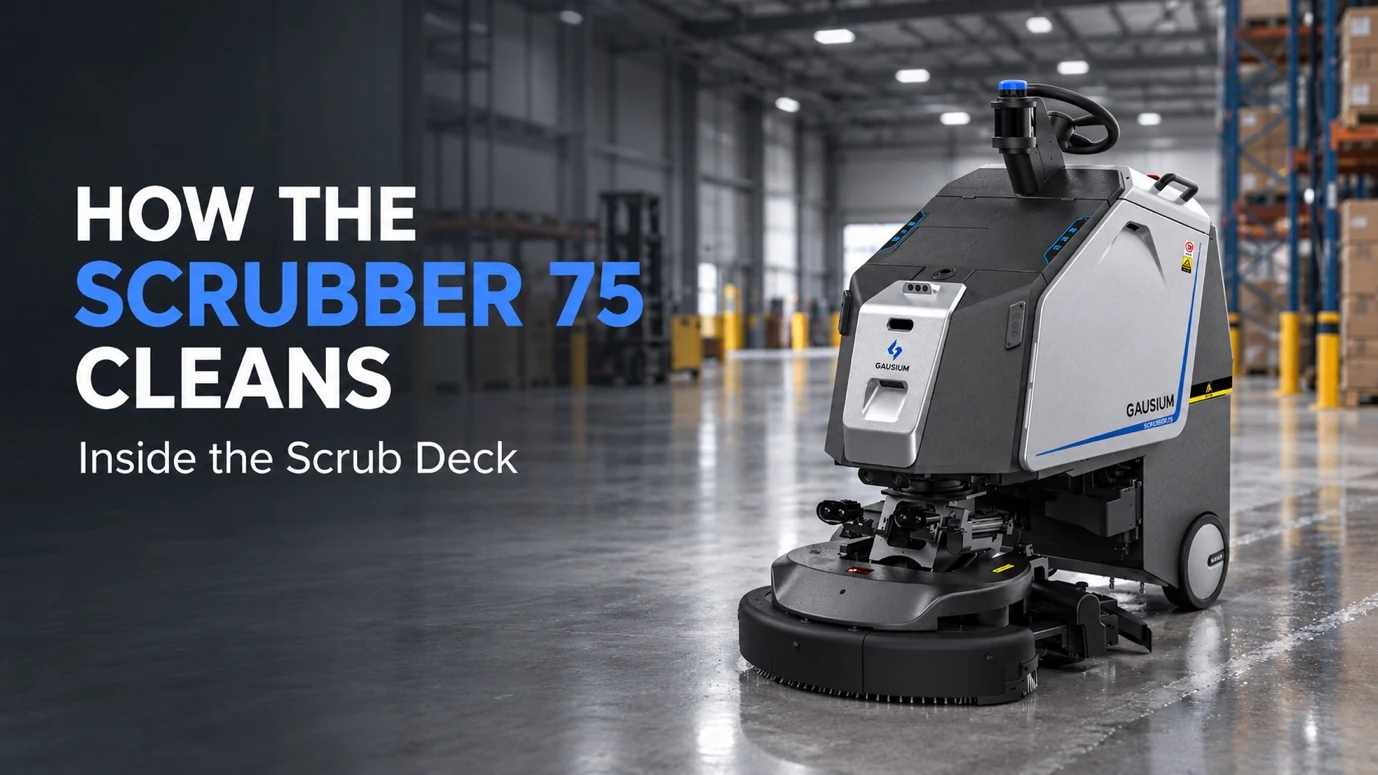
Large industrial and commercial floors present a consistent set of challenges. Warehouses collect fine dust, packaging fragments and tyre marks from forklifts. Car parks accumulate oil, rubber and grit. Factories and logistics hubs require clean, dry floors across tens of thousands of square metres, often during narrow cleaning windows. A robotic floor scrubber designed for these spaces must do more than move water across the surface. It needs a cleaning system that loosens soil, captures debris, recovers dirty water and leaves the floor dry and safe to walk on.
The Gausium Scrubber 75 is built around that requirement. This article explains how its underside cleaning system works, step by step, and how each component contributes to a consistent result on large-scale floors.
Key Specifications of the Cleaning System
| Parameter | Scrubber 75 |
|---|---|
| Cleaning width | 750 mm (three disc brushes) |
| Squeegee width | 960 mm |
| Brush down pressure | 45 kg |
| Brush speed | 270 rpm |
| Scrub deck rotation | 270° |
| Clean / waste water tank | 75 L / 50 L |
| Practical cleaning efficiency | 700 to 1,400 m²/h |
| Theoretical max. efficiency | 3,000 m²/h |
| Max. cleaning speed | 1.1 m/s |
| Gradeability / speed bumps | 8° / 50 mm |
| Runtime / charging time | Approx. 4 to 6 h / approx. 6 h |
| Suitable floors | Natural stone, artificial stone, ceramic, concrete, PVC and vinyl, epoxy |

The Cleaning Sequence in One Pass
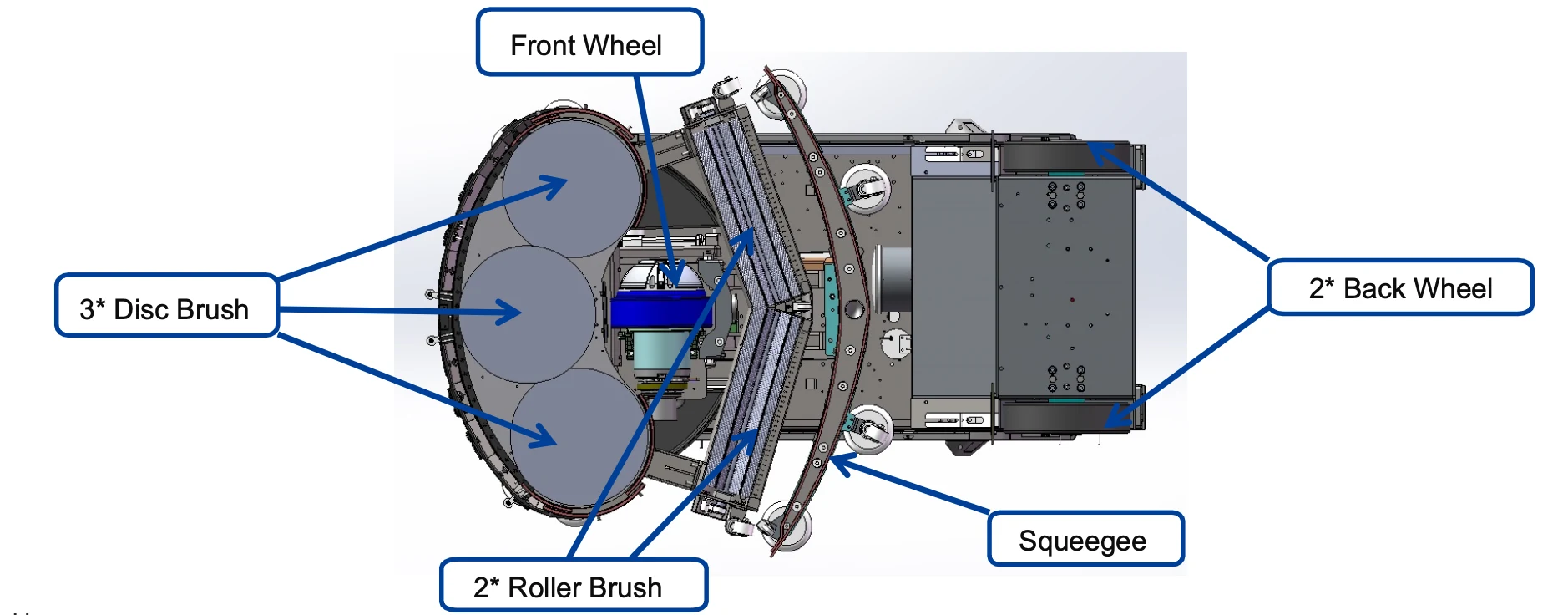
Every metre of floor the Scrubber 75 covers goes through the same sequence beneath the machine. Understanding this sequence explains why the robot can scrub and dry in a single pass rather than requiring separate sweeping and mopping rounds.
- Water and solution delivery. Clean water, with optional detergent, is dispensed onto the floor ahead of the brushes.
- Disc brush scrubbing. Three disc brushes apply downward pressure and rotation to break the bond between soil and floor.
- Roller brush sweeping. Two roller brushes lift small loose debris into a trash tray before it reaches the water recovery path.
- Squeegee recovery. A wide rear squeegee collects the dirty water, which is drawn by vacuum into the waste water tank.
- Filtration and reuse. Recovered water passes through a multi-stage filtration system and returns to the cleaning cycle.
The sections below look at each stage in more detail.
Disc Brush Scrubbing at 45 kg Down Pressure
The core of the Scrubber 75 is a three-disc brush deck with a combined cleaning width of 750 mm. Each brush rotates at 270 rpm, and the deck applies 45 kg of down pressure to the floor. This combination of pressure and rotational speed is what allows the robot to remove embedded grime, tyre marks and dried spills that light-duty machines tend to pass over.
Brush pressure matters because most industrial soil is not loose dirt. It is a film of dust, oil and fine particles that has been pressed into the floor surface by foot traffic and vehicles. Scrubbing force is needed to lift that film into suspension so it can be recovered by the squeegee. The disc deck also supports different brush types and cleaning pads, so the same robot can be configured for sealed concrete, epoxy, vinyl or stone.
The 270° Rotational Scrub Deck for Edges and Corners
Edges and corners are where conventional ride-on and walk-behind scrubbers often leave residue, because a fixed deck cannot follow the line of a wall into a right angle. The Scrubber 75 addresses this with a front-mounted scrub deck that rotates through 270°.
As the robot approaches a wall or a 90° corner, the deck can swing to keep the brushes in contact with the floor along the boundary. This lets the robot work cleanly along racking lines, column bases and room perimeters, and it allows the machine to clean while reversing in confined sections. The result is more complete coverage of the mapped area and less follow-up work for cleaning staff.
Roller Brush Sweeping and Debris Collection
Industrial floors rarely contain only liquid soil. Small items such as cigarette butts, toothpicks, peanut shells and fine packaging fragments are common in warehouses, retail back-of-house areas and car parks. On the Scrubber 75 P configuration, two roller brushes work alongside the disc brushes to sweep this debris into a pair of trash trays with a combined capacity of 1.3 L.
This sweeping stage serves two purposes. It removes visible litter from the floor in the same pass as scrubbing, and it keeps small solids out of the squeegee and suction line so that water recovery remains consistent throughout the task. In practice, this means facilities can combine sweeping and scrubbing into a single scheduled routine.
Squeegee Water Recovery for Dry Floors
A clean floor is only useful if it is also dry. Wet floors slow down operations and create slip risks for staff and visitors. The Scrubber 75 uses a 960 mm flexible, sealed squeegee, which is wider than the 750 mm brush path. Because the squeegee extends beyond both sides of the scrubbed track, it captures water that is pushed outward by the rotating brushes and leaves a dry finish behind the robot.
Recovered water is drawn by vacuum into the 50 L waste water tank. The wide squeegee profile is particularly valuable during turns and along edges, where water tends to spread beyond the brush footprint.
Multi-Stage Filtration and Water Recycling
Large-area scrubbing consumes a significant volume of water. To extend the area covered per tank and reduce freshwater use, the Scrubber 75 includes a built-in multi-stage filtration system. Recovered water passes through a dust sieve, a stainless steel sewage filter cartridge and a series of fine filters before it is reused for scrubbing.
According to Gausium, this water recycling system reduces freshwater consumption by approximately 80%. For a facility running daily scrubbing across several thousand square metres, that reduction translates into fewer refill stops, longer uninterrupted cleaning sessions and a measurable contribution to sustainability targets. Combined with the 75 L clean water tank, the filtration system allows the robot to cover substantially more floor area on a single fill than it could with fresh water alone.
Oil Cleaning Mode for Heavily Soiled Areas
Underground car parks, loading docks and manufacturing floors often carry oil and grease stains that water alone cannot lift. The Scrubber 75 includes a dedicated oil cleaning mode supported by an onboard detergent box. When the mode is active, the robot automatically mixes detergent into the scrubbing water at a configurable ratio between 1:200 and 1:50.
Detergent use can be assigned to specific zones. For example, a loading bay with heavy oil contamination can be set as one subtask with detergent enabled, while the surrounding warehouse aisles are cleaned with water only. The robot combines these subtasks into a single run and switches automatically between the two settings as it moves from zone to zone. This targeted approach keeps detergent consumption under control while giving the most demanding areas the treatment they need. Gausium recommends a cleaning speed of 0.6 to 0.8 m/s for oil cleaning tasks and a non-foaming detergent within a pH range of 2 to 14.
In car park environments, the robot is also able to identify occupied and vacant parking spaces and focus its cleaning on the available areas, which improves overall efficiency during operating hours.
Workstation Integration for Continuous Operation
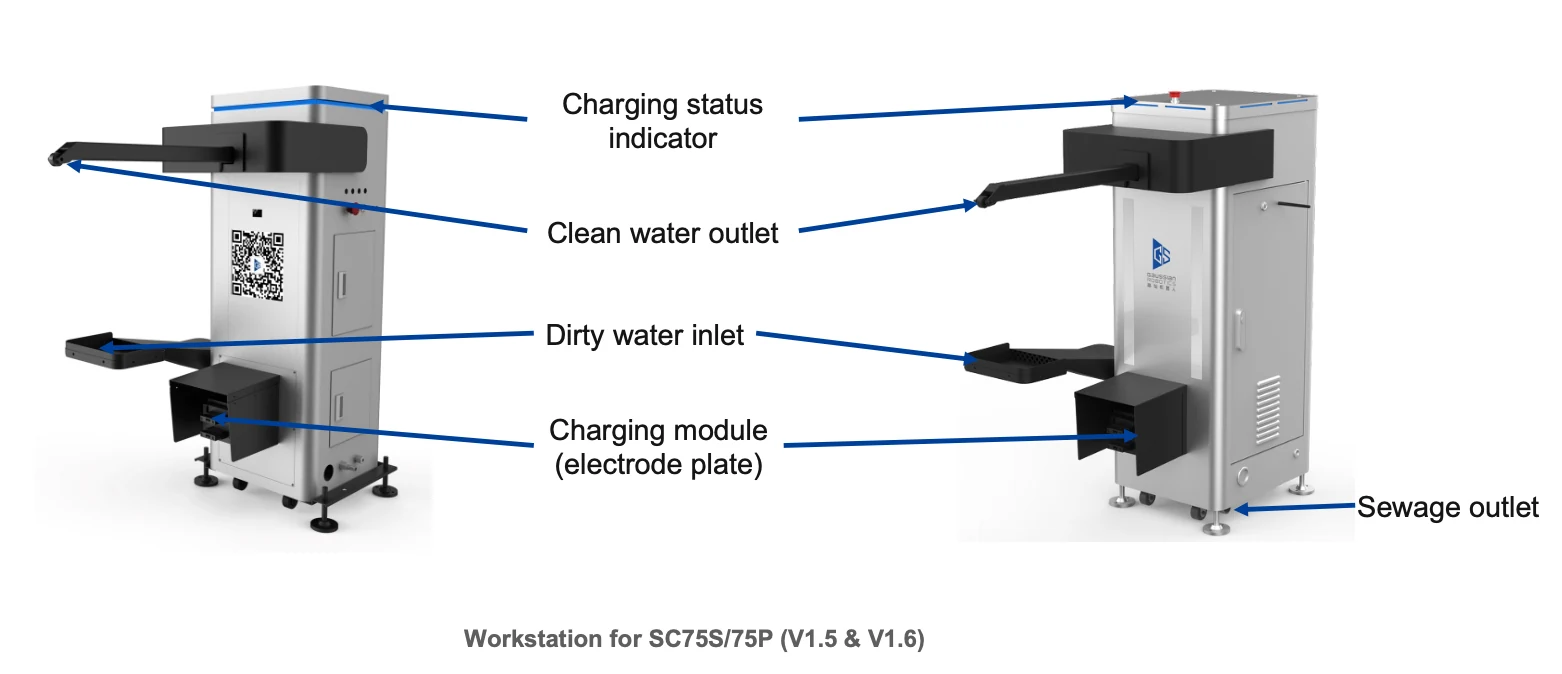
The cleaning system is designed to work with the Gausium workstation for fully autonomous operation. When the battery reaches its low threshold, the clean water tank is empty or the waste water tank is full, the robot returns to the workstation on its own. There it recharges, refills clean water, discharges waste water and has the recovery tank rinsed, then resumes the task.
With a workstation in place, the Scrubber 75 can extend its cleaning sessions well beyond a single tank or battery cycle, making it suitable for sites larger than 2,000 m² that need consistent daily coverage with minimal staff involvement. Day-to-day human input is limited to routine maintenance, which can be scheduled at a convenient time.
Manual Mode for Flexible Deployment
The Scrubber 75 can also be operated manually. A stand-on pedal platform and a steering wheel allow an operator to drive the machine directly when needed, for example to clean a one-off spill or to reposition the robot between sites. Switching between autonomous and manual operation takes a single action on the 10-inch touchscreen. The same scrub deck, squeegee and filtration system remain active in both modes, so cleaning quality stays consistent regardless of how the robot is being driven.
Applications Across Industrial and Commercial Sites
The combination of high brush pressure, integrated sweeping, wide squeegee recovery and water recycling makes the Scrubber 75 well suited to medium and large floor areas, typically from 2,000 m² to 60,000 m². Typical deployments include:
- Warehouses and distribution centres, where forklift tyre marks and fine dust build up along aisles and dock areas.
- Manufacturing plants, where oil, grease and production residue require regular deep scrubbing.
- Underground and multi-level car parks, where oil cleaning mode, 8° gradeability and 50 mm speed bump clearance support operation across ramps and parking bays.
- Airports, train stations and transport hubs, where large open concourses need frequent cleaning around continuous foot traffic.
- Large-format retail and wholesale stores, where wide aisles and hard floors benefit from scheduled overnight scrubbing.
Frequently Asked Questions
How does a robotic floor scrubber clean differently from a manual scrubber?
A robotic floor scrubber such as the Scrubber 75 follows a mapped route with consistent brush pressure, speed and water flow on every pass. This removes the variation that comes with different operators and shifts, and it allows cleaning to run on a fixed schedule, including overnight.
Can the Scrubber 75 remove oil stains?
Yes. The oil cleaning mode mixes detergent into the scrubbing water at a configurable ratio and can be assigned to specific zones, making it effective for car parks, loading docks and production floors.
How much water does the Scrubber 75 save?
The built-in multi-stage filtration system recycles recovered water for reuse, reducing freshwater consumption by approximately 80% according to Gausium.
What floor types is the Scrubber 75 suitable for?
It is suitable for natural stone, artificial stone, ceramic, concrete, PVC and vinyl, and epoxy floors.
Does the Scrubber 75 clean corners and edges?
Yes. Its 270° rotational scrub deck allows the brushes to follow walls and reach 90° corners, improving coverage along perimeters and racking lines.
Learn More About the Scrubber 75
The Scrubber 75 brings together scrubbing, sweeping, drying and water recycling in a single autonomous platform built for large-scale floors. To review full specifications or arrange an on-site demonstration, visit the Scrubber 75 product page or contact our team.