
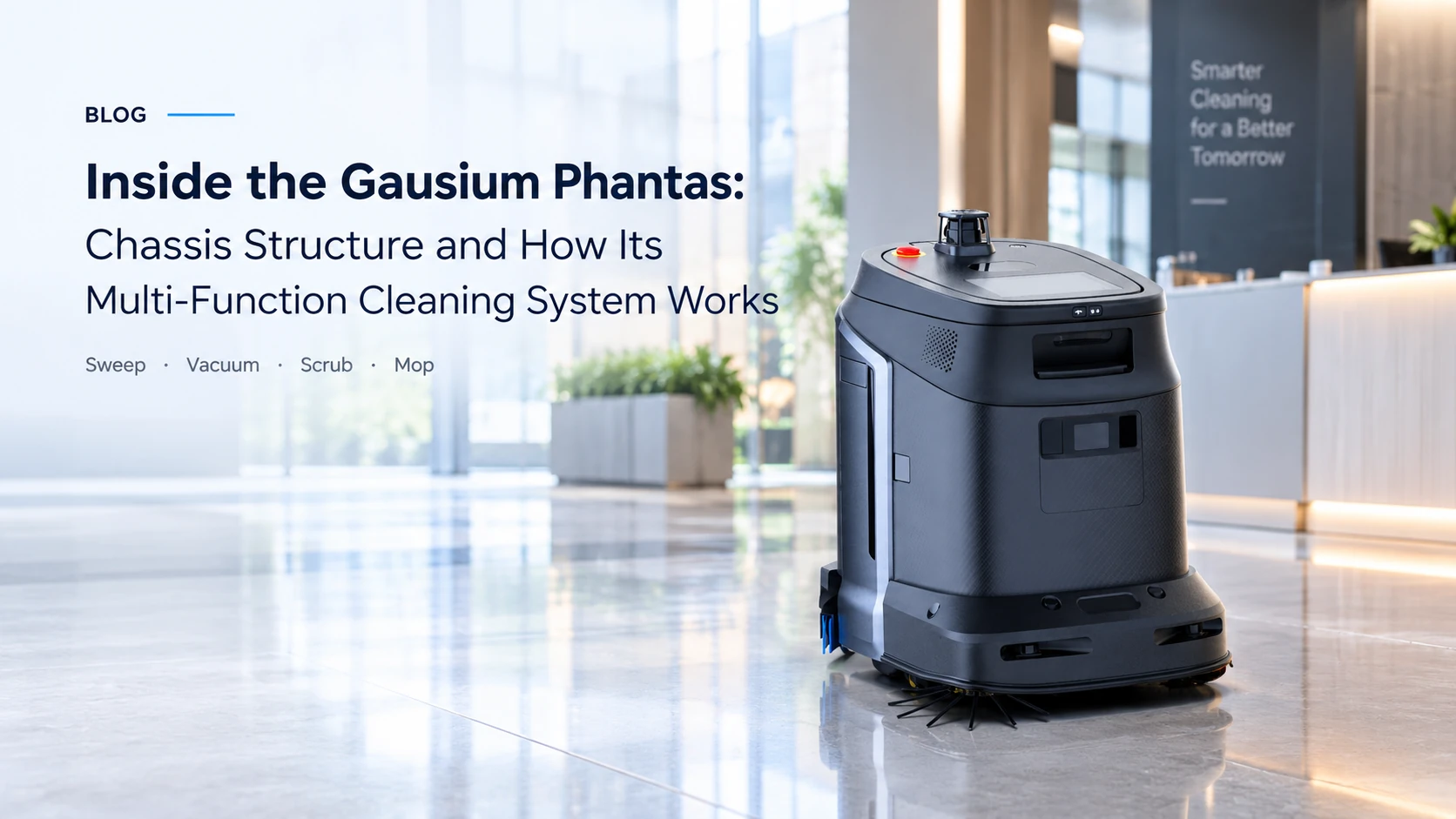
A cleaning robot is only as good as the system underneath it.
Retail stores, hotels, offices, hospitals and residential buildings rarely need just one thing done to the floor. Loose debris has to be picked up. Fine dust has to be lifted before it works into the finish. Spills and the grey film left by foot traffic need water and mechanical pressure. Carpeted areas need something different again.
The Gausium Phantas is built around that reality rather than around a single task. Its chassis carries roller brushes, a side brush, a squeegee, two water tanks, a debris tray and a dust collection system, and the machine changes cleaning mode to suit the floor in front of it.
What follows is what each of those parts does, and why the combination matters more than any one of them.
A compact chassis with a lot inside it
The Phantas V1.3 measures approximately 540 × 440 × 617 mm and weighs around 53 kg. Minimum passing width is 600 mm, minimum U-turn width approximately 750 mm, and minimum edge cleaning distance 0 mm.
Everything described below fits inside that envelope, which is the first thing worth appreciating about the design. A scrubbing system and a dry collection system in the same body, on a footprint that still gets down a narrow aisle and under a table.
The dry path runs side brush, then roller brushes, then debris or dust collection. The wet path runs clean water, roller brush, squeegee, suction, waste water tank. Both share the same chassis, and the cleaning accessories change according to the task.
The side brush: bringing the edges into reach
Sweeping starts before the main brushes touch anything.
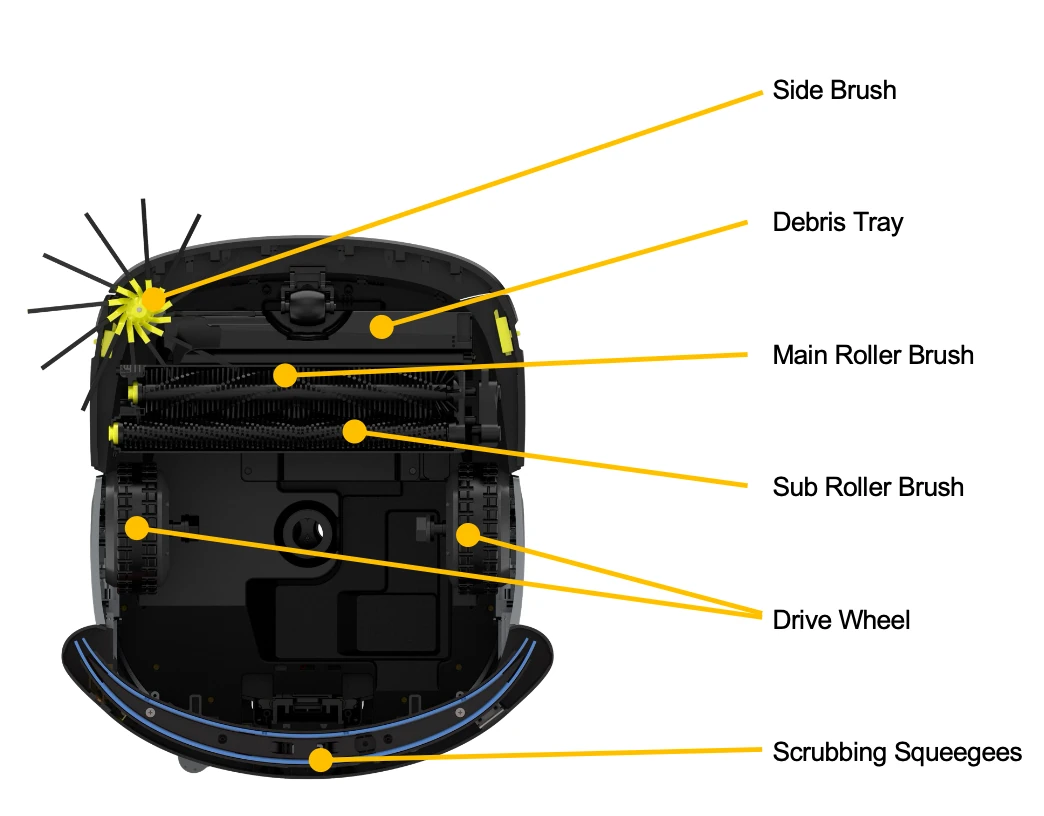
The Phantas carries a single side brush that rotates inward, sweeping small debris from along skirtings, fixture bases and corners toward the underside of the machine. Without it, anything sitting outside the roller brush path simply stays where it is.
Edge debris, side brush, main cleaning area. That sequence is what produces the published minimum edge cleaning distance of 0 mm, and it matters more than it sounds in retail and hospitality. The middle of a floor gets walked on and keeps a certain sheen. The strip against the wall does not, and it is the part customers notice.
Two roller brushes, and the configurations they accept
The defining feature of the Phantas chassis is its two-roller-brush arrangement, and more specifically what those brushes can be changed to.
The roller brushes collect debris during sweeping and vacuuming and do the mechanical work during scrubbing. Gausium supplies different brush configurations for different applications: general cleaning, deep scrubbing, carpet vacuuming and dust mopping. Deep scrubbing uses dedicated roller brushes. Carpet vacuuming uses specific front and rear roller configurations. Dust mopping pairs a roller cloth with a roller brush.
This is the actual answer to how one machine performs four different jobs. Not clever software deciding to behave differently, but a chassis that accepts the right tool for the surface.
A hard floor, a carpeted area and a heavily soiled back-of-house floor do not respond to the same mechanism, and forcing one brush to attempt all three produces a machine that does none of them properly. For anyone specifying a cleaning robot, the question is not whether it can clean. It is whether it can bring the right cleaning method to this particular floor.
Sweeping and vacuuming: two different kinds of dry
In sweeping mode the roller brushes collect solid debris and transfer it into a dedicated 0.7 L debris tray. Published sweeping runtime reaches approximately 14 hours depending on conditions.
Vacuuming addresses the other half of the dry problem. Using the appropriate roller configuration together with the dust collection system, fine particulate goes into a 6 L dust bag with a service interval of roughly three to seven days.
Sweeping deals with what you can see. Vacuuming deals with what you cannot. The three-to-seven-day bag interval is the figure worth holding onto, because it turns a daily chore into a weekly one, and the amount of attention a machine demands each day decides more deployments than throughput ever does.
Scrubbing: a closed loop rather than a wet floor
Wet cleaning is where the chassis gets more involved. Instead of collecting dry material, the machine puts water onto the floor, works it mechanically, then takes it back off again.
The V1.3 carries an 11.5 L clean water tank and a 10.5 L waste water tank, scrubs a 330 mm path, and runs approximately four to four and a half hours in this mode.
- Clean water. Water is fed from the clean tank to the cleaning head.
- Roller brush. The brush agitates the surface and lifts adhered soil.
- Squeegee. The squeegee gathers the water and loosened dirt left behind the brush.
- Suction. Airflow draws that recovered liquid up into the machine.
- Waste water tank. Dirty water is held in the 10.5 L tank until it is drained.
The recovery half is what separates a scrubber from a mop. A mop redistributes dirty water and leaves it to dry. A scrubber takes it back off the floor, which is why the surface behind the machine should be close to dry rather than merely clean and wet.
Why the squeegee is wider than the scrub path
One number in the specification looks like a mistake until you think about it. The scrubbing width is 330 mm, but the squeegee measures 490 mm.
The extra 160 mm is deliberate. Water does not stay neatly inside the brush path. It spreads a little as it is worked, and the machine does not travel in a perfectly straight line, particularly on turns and gentle curves where the rear of the chassis tracks slightly differently from the front. A squeegee matched exactly to the scrub width would miss water on every corner.
Making the squeegee substantially wider means the recovery system still collects everything the brush put down, whatever the machine happened to be doing at the time. It is a standard piece of commercial scrubber design, and it is a reasonable thing to check on any machine you are considering.
Compact does not mean limited
The manoeuvring figures are what let the Phantas work buildings that are still in use.
- 600 mm minimum passing width
- 650 mm minimum passing height
- 750 mm minimum U-turn width
- 0 mm minimum edge cleaning distance
- 35 mm maximum gap pass-over width
- 17 mm maximum obstacle pass-over height
- Maximum cleaning speed of 0.8 m/s
The height figure is the one most people skim past. A machine that passes under a 650 mm opening reaches beneath fixed counters, display units and desk runs, which is exactly where dust gathers and exactly where a walk-behind machine cannot go without someone shifting furniture first.
The 35 mm gap and 17 mm obstacle figures set the other boundary, and they are the ones to measure against your own thresholds, cable covers and floor transitions before anything is ordered.
These proportions suit retail stores, hotels, office buildings, hospitals, residential apartments, school corridors and exhibition halls, which is where Gausium positions the machine.
Maintenance: what a person actually has to do
A robot is not autonomous if someone still performs every maintenance task by hand, and the Phantas components that need regular attention are built to come apart quickly.
The waste water tank detaches, so it can be removed and flushed without wheeling the whole machine to a drain. The roller brushes detach for cleaning. The debris tray pulls out, empties, cleans and refits, with Gausium putting that cycle at under a minute.
The squeegee rubber takes four steps: remove the cover, pull out the rubber strip, clean it, refit. The side brush uses a magnetic mount and comes off with a press.
None of this is glamorous, and all of it is the difference between a machine that is still running in month six and one parked against a wall.
What happens between shifts
Wet cleaning creates a maintenance problem that dry cleaning does not. Dirty water left standing in a recovery tank goes stale, the squeegee dries with soil on it, and the suction pipe gradually restricts. Left alone that produces smell and blockage, and in food retail it produces a conversation nobody enjoys.
Two levels of docking are available. The basic charging dock handles charging alone. The optional workstation adds automatic clean water refilling, waste water drainage and self-cleaning, rinsing the suction pipe, the waste water tank and the squeegee when the machine returns.
Where a site has no suitable water supply or drain near the parking position, a mobile water tank supplies clean water and collects waste water instead, so the arrangement can be built around the building rather than requiring the building to accommodate the robot.
The complete cleaning cycle
Put the parts together and three paths run through the same chassis.
Dry. Side brush, then roller brushes, then debris or dust collection, into the debris tray or the dust bag.
Wet. Clean water tank, then roller brush scrubbing, then squeegee, then suction, into the waste water tank.
Automated maintenance. Docking, then charging, then water refill, then waste water drainage, then self-cleaning.
Each stage depends on the one before it, which is why the chassis is better understood as a system than as a collection of parts.
What to look at when you compare machines
Navigation is the feature that gets demonstrated and the one that tells you least. The questions that decide performance on a real floor are mechanical and operational.
Ask which cleaning methods the floor actually needs, and whether the machine can be configured for each of them rather than attempting all of them with one brush. Ask what the recovery system does with dirty water between shifts. Ask how many minutes a day someone has to spend on the machine, and what those minutes involve. Ask whether it reaches the edges, and whether it fits under the fixtures where dust collects.
Read the Phantas chassis against those questions and it is not a vacuum with a water tank attached. It is a side brush, two interchangeable roller brushes, a scrubbing and recovery circuit, a dust collection system and an automated dock, built into a footprint small enough to work a floor while the building is still being used.
Specifications — Phantas V1.3
| Specification | Gausium Phantas V1.3 |
|---|---|
| Cleaning modes | Sweeping, vacuuming, scrubbing, dust mopping |
| Main brush system | 2 × roller brushes, configurable by application |
| Side brush | 1, magnetic mount |
| Scrubbing width | 330 mm |
| Squeegee width | 490 mm |
| Edge cleaning distance | 0 mm |
| Clean water tank | 11.5 L |
| Waste water tank | 10.5 L, detachable |
| Debris tray | 0.7 L |
| Dust bag | 6 L, approximately 3–7 days between changes |
| Runtime | Sweeping up to approximately 14 h · scrubbing approximately 4–4.5 h |
| Dimensions | 540 × 440 × 617 mm |
| Weight | Approximately 53 kg |
| Minimum passing width / height | 600 mm / 650 mm |
| Minimum U-turn width | Approximately 750 mm |
| Maximum gap pass-over | 35 mm |
| Maximum obstacle pass-over | 17 mm |
| Maximum cleaning speed | 0.8 m/s |
| Docking options | Charging dock, or workstation with refill, drainage and self-cleaning |
Figures refer to the Phantas V1.3 and are drawn from Gausium product documentation. Specifications vary by version and are subject to change; confirm against the current Gausium Phantas specifications before purchase.