
| Location | Milan Malpensa and Milan Linate airports, Italy |
|---|---|
| Sector | Aviation and transport terminals |
| Equipment | Gausium Omnie autonomous cleaning robot |
| Deployed | February 2026, ahead of the Milano Cortina 2026 Winter Games |
| Operating pattern | Continuous, with passengers present at all hours |
In February 2026, Gausium deployed Omnie cleaning robots into live passenger terminals at Milan Malpensa and Milan Linate, ahead of the traveller volumes generated by the Milano Cortina 2026 Winter Games.
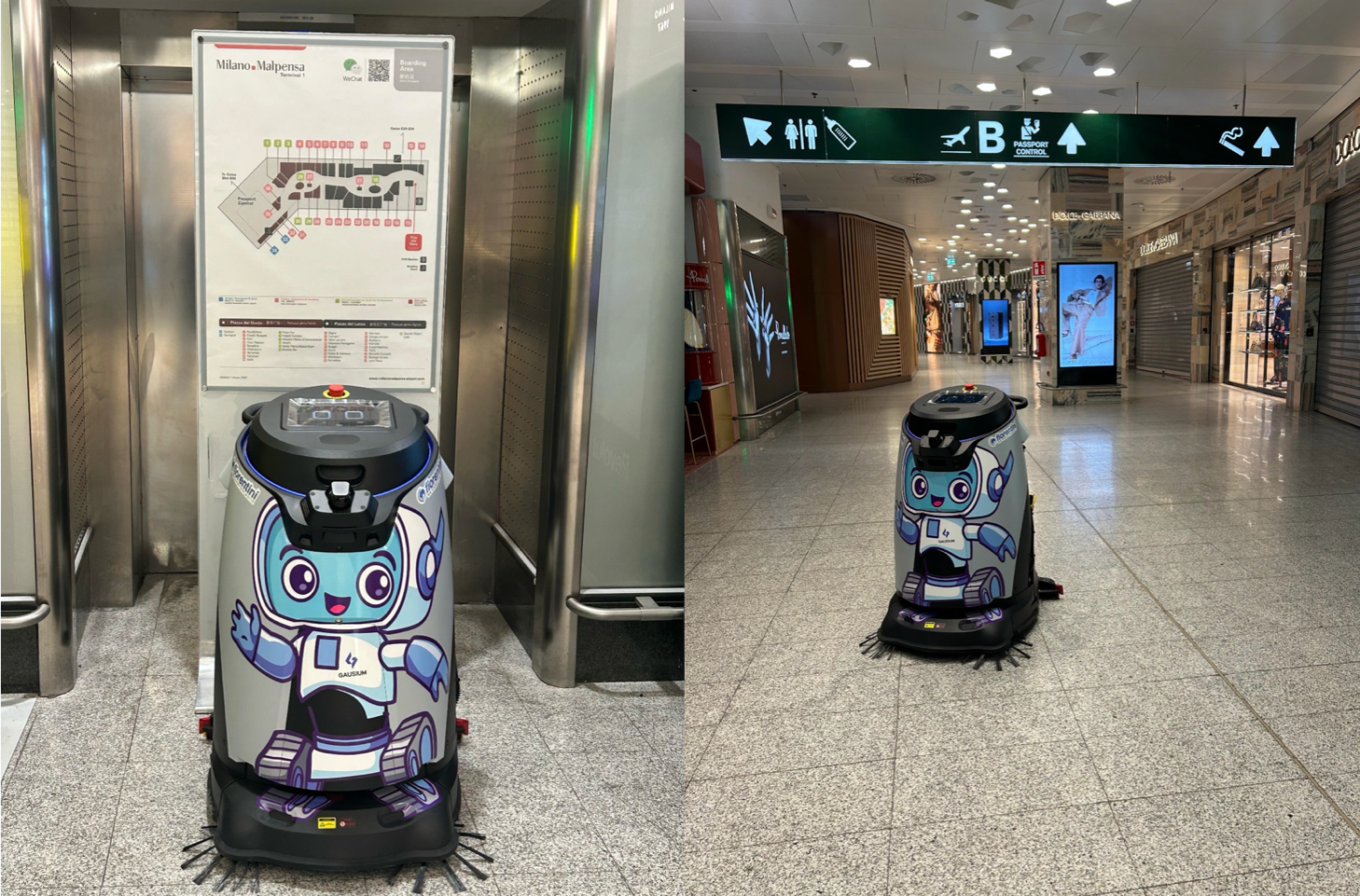
Both airports operate around the clock. The image above was taken during one of the quieter periods at Malpensa Terminal 1, with much of the concourse retail closed, and even then the floor is in public use. For an autonomous cleaning machine this removes the condition that most commercial cleaning robots are specified against: a defined window in which the floor is clear of people.
What a continuously operating terminal demands
A warehouse or a shopping centre provides a predictable gap. After the last pick, or after trading closes, a machine has four to six hours of uninterrupted floor and can complete a site in a single run. An international terminal offers no equivalent. Aircraft arrive through the night, cleaning takes place among passengers, and the work is distributed across short repeated cycles rather than one continuous shift.
Three characteristics follow from that, and each one places a specific demand on the equipment.
The first is unpredictable obstruction. Luggage trolleys are abandoned mid-floor, queues form within minutes in areas that were clear, and passenger movement does not follow fixed paths. A machine that halts at every unanticipated object will not complete a route.
The second is surface complexity. Polished stone, glass partitions, mirrored retail frontage and backlit glazing all appear within a few metres of one another, and each presents a different difficulty for a different sensing method.
The third is distance. Water and power access points are limited and rarely located near the areas that require attention, so every refill and recharge carries a travel cost.
How the Omnie is configured for it
The Omnie carries 3D LiDAR, 2D LiDAR, a 3D depth camera and an RGB camera, supported by anti-collision and anti-drop sensing. The redundancy across sensing methods is deliberate, and it is what allows the machine to hold a route through reflective and glazed environments rather than stopping. Anti-drop sensing is particularly relevant in terminals, which contain travelators, ramps and frequent level changes.
The machine measures 810 × 700 × 1,070 mm and requires 800 mm of aisle width and 1,100 mm to complete a turn. That envelope allows it to work check-in queue lanes and the space between rows of gate seating, rather than being restricted to open concourse. Maximum operating speed is 1.4 m/s.
Three cleaning modes are available on the one platform. Scrubbing operates at 520 mm on a disc brush, or 406 mm on a roller brush extending to 780 mm with side brushes fitted. Sweeping and dust mopping are also supported. A terminal produces all three soil types concurrently: grit carried in from outside, food and beverage spills, and fine particulate settling across hard floor.
Tank capacity is 33 litres clean and 24 litres recovered. The modest capacity is a consequence of the compact envelope, and it is a reasonable trade in a building where access to queue lanes and seating areas matters more than extended running between refills.
Charge time as a selection criterion
For continuously operating sites, charge time deserves more attention than it usually receives during equipment selection.
The Omnie provides three hours of scrubbing runtime, and eight hours in sweeping or dust mopping, from a 60 Ah lithium iron phosphate battery. Recharge takes approximately two hours. The machine is therefore designed to cycle through the day, returning to charge and resuming, rather than to complete a single extended overnight run.
In a building that closes, runtime is the determining figure. In a building that does not, charge time determines how many productive cycles are available in each 24-hour period.
Sizing an equivalent site
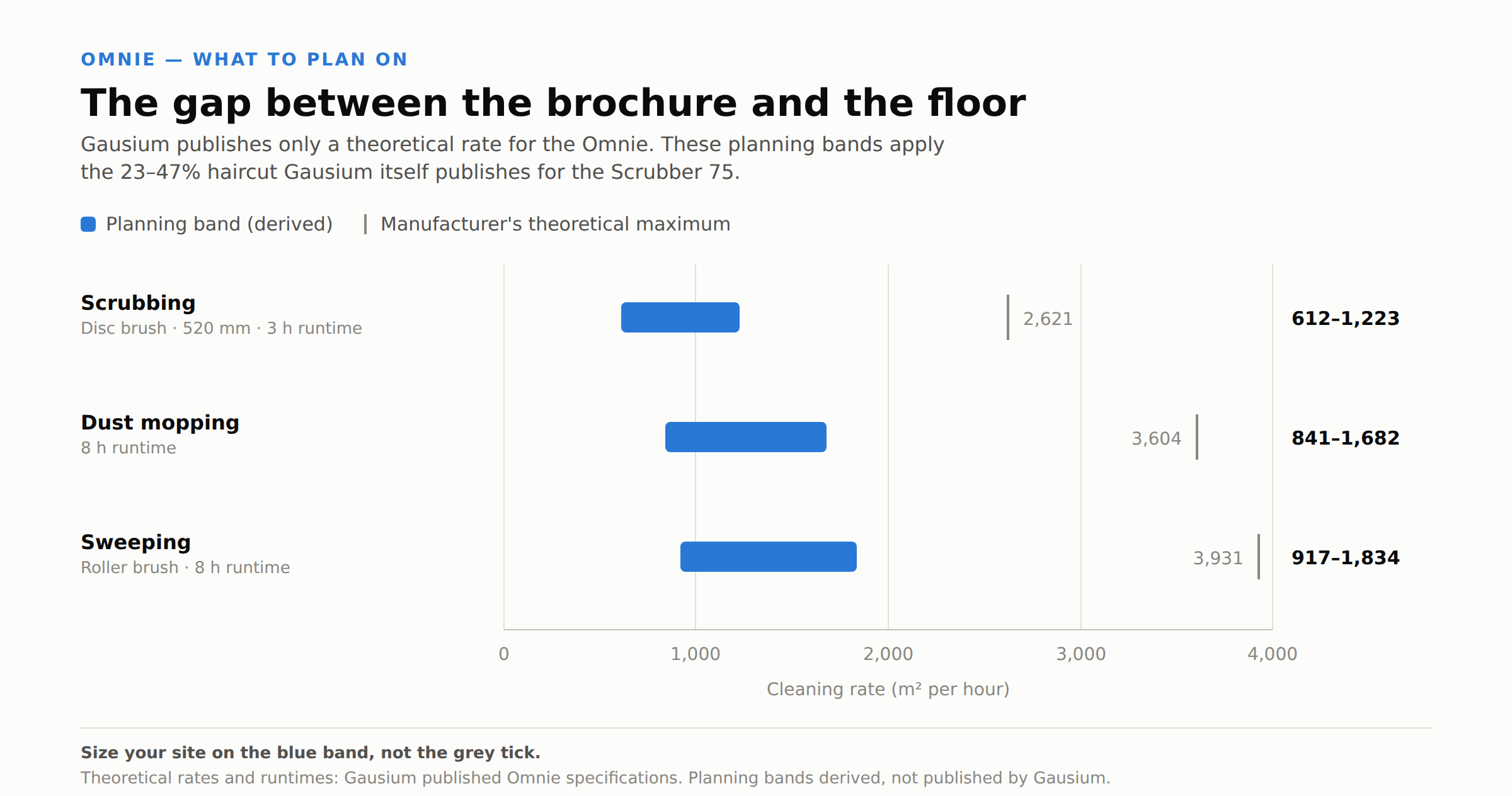
Gausium publishes theoretical cleaning rates for the Omnie. When we size a site, we work instead from indicative planning figures, derived by applying the theoretical-to-practical relationship that Gausium publishes for the Scrubber 75, where practical efficiency is stated at 23 to 47 per cent of theoretical.
| Mode | Published theoretical | Indicative planning figure |
|---|---|---|
| Scrubbing (disc, 520 mm) | 2,621 m²/h | 612–1,223 m²/h |
| Dust mopping | 3,604 m²/h | 841–1,682 m²/h |
| Sweeping (roller) | 3,931 m²/h | 917–1,834 m²/h |
On that basis, a single Omnie operating an eight-hour dust mopping cycle covers in the order of 10,000 m². Planning figures are refined by measurement once a machine is operating on site.
Comparable environments in Australia
The Omnie succeeds the Scrubber 50, retaining its footprint, weight and battery while adding a sweeping mode, a wider disc and a higher operating speed. Milan’s terminals represent an extreme case of a site type that is well represented in Australia: buildings that operate with the public on the floor for most or all of the day.
Suitable environments include:
- Airport and rail terminals
- Shopping centres with extended trading hours
- Hospital public areas and outpatient corridors
- Hotel lobbies and large foyers
- Transport interchanges
Where a building does close and offers a genuine four to six hour window across large open floor, a higher-capacity machine will generally deliver better economics, and we will recommend accordingly.
Site assessment
We size equipment against the specific conditions of each building. To begin an assessment, provide your floor area, trading or operating hours, floor surfaces, and the location of water and power access points. We will return an indicative sizing, together with the figures and assumptions used to produce it.
Sources
Gausium announcement, Omnie robots at Milan Malpensa and Linate airports (February 2026) · Gausium published Omnie specifications · Gausium published Scrubber 75 specifications · Photo: Gausium.