
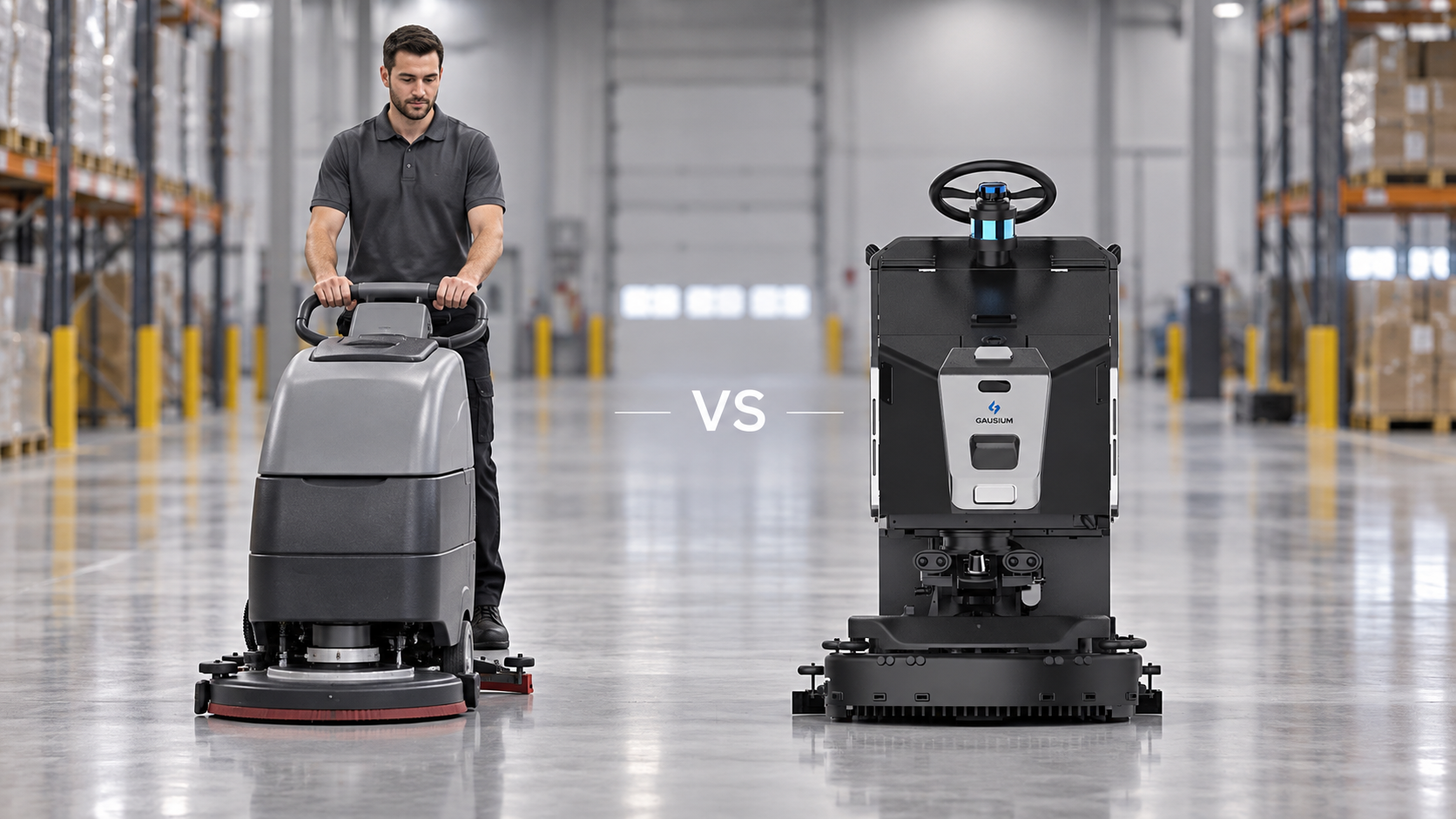
Most comparisons between cleaning robots and traditional scrubbers are written by someone selling one of them. So let’s do this the other way around: start with the published specifications from both manufacturers, run the arithmetic against current Australian award rates, and be clear about where the robot loses.
We sell Gausium robots. We’d rather you buy one for the right reason.
Throughput: the robot is slower
This is the part the marketing usually skips.
| Machine / configuration | Published estimate |
|---|---|
| T300 · 500 mm self-propelled | 1,388 |
| T300 · 600 mm self-propelled | 1,697 |
| Scrubber 75 · 750 mm | 700–1,400 |
| Scrubber 50 · 460 mm | 500–1,300 |
| Phantas · 330 mm scrubbing width | 350–700 |
Adapted from the supplied chart, with the T300 configurations distinguished. Manufacturer estimates are not like-for-like test results.
Published estimates for different configurations; methods and real-world conditions differ.
Gausium publishes theoretical and practical efficiency figures. The Scrubber 75 has a 750 mm cleaning width and a practical range of 700–1,400 m²/h. Tennant’s published T300 conventional estimates include 1,388 m²/h for a 500 mm self-propelled configuration and 1,697 m²/h for a 600 mm configuration. These are manufacturer estimates under different methods, not a controlled head-to-head trial.
A wider cleaning deck does not necessarily mean greater hourly coverage. Autonomous operation must accommodate people, obstacles and route constraints. Manual performance also depends on turning, refilling, access and the operator.
Hourly speed alone is not a sound basis for choosing either machine. A manual scrubber can offer higher hourly coverage in these published examples; the ranges overlap and actual site results can differ.
It is also the wrong unit to buy on.
Per shift, the robot covers more
An hour is not what you buy. You buy a shift.
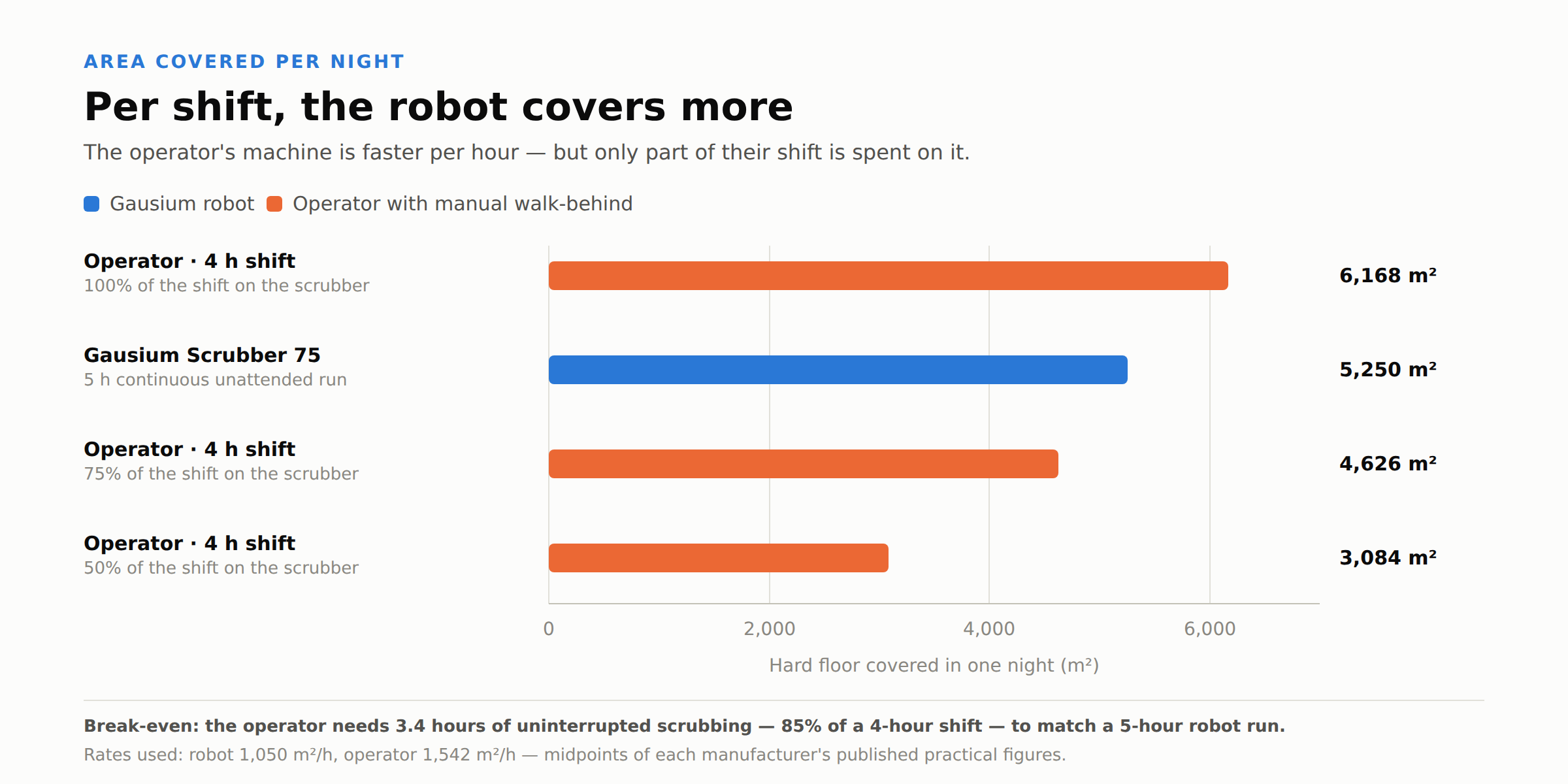
Illustrative scenario: 1,542 m²/h for the manual machine and 1,050 m²/h for the robot. The manual input is a rounded representative value across selected T300 configurations, not a specific 500 mm model rating.
Two things happen across a shift that don’t show up in an hourly rate.
A Scrubber 75 has a published runtime of approximately 4–6 hours. The time available for floor care depends on battery condition, refills, charging, floor conditions and the site’s operating window. A trial should establish the achievable run time.
And all of it is floor. An operator on a four-hour night shift is not scrubbing for four hours. They are also emptying bins, doing amenities, dusting, handling spills and moving between areas. The scrubber runs for whatever fraction of the shift is left over. The robot has no other duties — its entire run is floor care.
Put those together and the arithmetic turns over. At the published practical rates, a five-hour robot run covers 5,250 m². To match it, an operator needs 3.4 hours of uninterrupted scrubbing — 85% of a four-hour shift with nothing else done. At a more realistic 75% of the shift on the machine, they cover 4,626 m²; at 50%, 3,084 m².
In this scenario, five productive robot-hours cover more than a manual scrubber used for 50–75% of a four-hour shift. A manual machine used for all four hours covers more. Neither outcome is universal.
Robots can provide repeatable routes and coverage logs, helping managers see where work was completed. Both manual and robotic equipment experience interruptions. Published practical estimates already allow for some operating losses, so avoid double-counting those losses when building your own model.
Labour: where the value actually is
The potential value comes from reducing the operator time tied to repetitive floor cleaning. Human supervision, setup and servicing still have a cost.
The Cleaning Services Award Level 1 adult full-time base rate is $27.08/hour from the first full pay period on or after 1 July 2026. Applicable full-time penalties include 130% for permanent night shifts, 150% for Saturdays and 200% for Sundays. Part-time, casual and other classifications differ. Superannuation reached 12% on 1 July 2025. The simplified model below adds a total 15% on-cost allowance; this is an assumption, not a complete employment-cost calculation.
That is the number the robot is competing against — not the manual scrubber’s throughput.
The ROI model, with the assumptions on the table
Here is a worked example for a mid-size site. Change any input and the answer changes; that’s the point of showing it.
Assumptions
| Input | Value |
|---|---|
| Open hard floor area | 6,000 m² |
| Cleaning frequency | 6 nights per week |
| Manual: Tennant T300 practical rate | 1,542 m²/h (representative assumption) |
| Robot: Gausium Scrubber 75 practical rate | 1,050 m²/h (midpoint) |
| Human time still attached to the robot | 1.2 h per night |
| Award Level 1 base, from 1 July 2026 | $27.08/h |
| On-costs (super 12% + workers’ comp allowance) | +15% |
The arithmetic
Manual scrubbing: 6,000 ÷ 1,542 = 3.9 operator-hours per night
Robot productive cleaning time: 6,000 ÷ 1,050 = 5.7 hours per night, before any additional downtime.
Human time retained: setup, water handling, charging assistance and detail work = an assumed 1.2 hours. Charging wait time is separate from hands-on labour.
Labour released: 2.7 h per night 839 hours per year
What those hours are worth
| Shift being displaced | Loaded hourly cost | Labour released per year |
|---|---|---|
| Day shift (base rate) | $31.14 | $26,100 |
| Permanent night shift (130%) | $40.48 | $34,000 |
| Sunday rate sensitivity (200%)* | $62.28 | $52,300 |
Payback on labour released alone
| Capital cost | Day shift | Permanent night |
|---|---|---|
| $40,000 | 18 months | 14 months |
| $55,000 | 25 months | 19 months |
| $70,000 | 32 months | 25 months |
Two caveats, stated plainly. First, this is gross labour released — your service agreement, consumables and power still come off it. Second, we have left capital cost as a variable rather than quoting a number we’d have to qualify; ask us for a delivered price on your actual site and we’ll put it into this same table.
Within this simplified model, valuing the released hours at a higher applicable rate shortens gross payback. Actual cash savings require paid hours or outsourcing costs to fall; redeploying staff releases capacity but does not automatically reduce payroll.
An operational detail worth knowing
The example requires 5.7 productive hours to cover 6,000 m², close to the top of the Scrubber 75’s published 4–6 hour runtime. It holds 75 litres of clean water and has an approximate full charging time of five hours. Refilling or recharging may be required, depending on conditions and configuration. If charging is needed, the elapsed cleaning window must be longer; 1.2 hours of human involvement does not remove that downtime.
Confirm water use, runtime, charging arrangements and human involvement in a site trial. Do not assume a fully unattended overnight result.
The full comparison
| Dimension | Manual walk-behind | Gausium robot |
|---|---|---|
| Throughput per hour | 1,388–1,697 m²/h across selected 500/600 mm configurations | Lower (700–1,400 m²/h at 750 mm) |
| Hours of floor care per shift | A fraction of the shift — the rest is bins, amenities, spills | Floor-focused operation; rated runtime about 4–6 h |
| Area covered per night | ~3,100–4,600 m² on a 4 h shift | ~5,250 m² on a 5 h run |
| Labour per operating hour | One full award hour | Reduced operator time; support still required |
| Best economics | Day shift, small or complex areas | Night and weekend shifts, large open floors |
| Edges, corners, detail | Operator handles it as they go | Allow for manual detail work; model and site dependent |
| Stairs, amenities, high-touch | Cleaning team handles these tasks | No |
| Consistency | Varies by operator and by night | Repeatable routes; conditions affect results |
| Reporting | Manual sign-off | Coverage logs per run |
| Capital exposure | Lower | Higher; consider leasing before buying |
| If it breaks down | Swap in a spare, shift continues | Shift reverts to manual — have a fallback |
| Water on board | 42 L (T300) | 75 L (Scrubber 75) |
So when does a robot actually pay?
Four conditions, and you want most of them:
Large, open, repetitive hard floor — 3,000 m²+ with room to run.
The shift you’d displace carries penalty rates — nights and weekends are where the case is strongest.
You have the shift window — 5–6 hours of clear floor, not a 2-hour gap.
Someone owns the machine on site — refills, dumps, and a weekly check. Deployments fail on this one more than on technology.
For smaller, obstructed or tightly scheduled sites, a manual scrubber may be the better option. Carpeted areas require an appropriate cleaning method, and amenities, stairs and high-touch surfaces still need people. We assess the full workload before recommending a machine.
Want this run on your site?
Send us your floor area, shift pattern and current award classification, and we’ll put your numbers through the same model above — including the parts where the answer is no.