
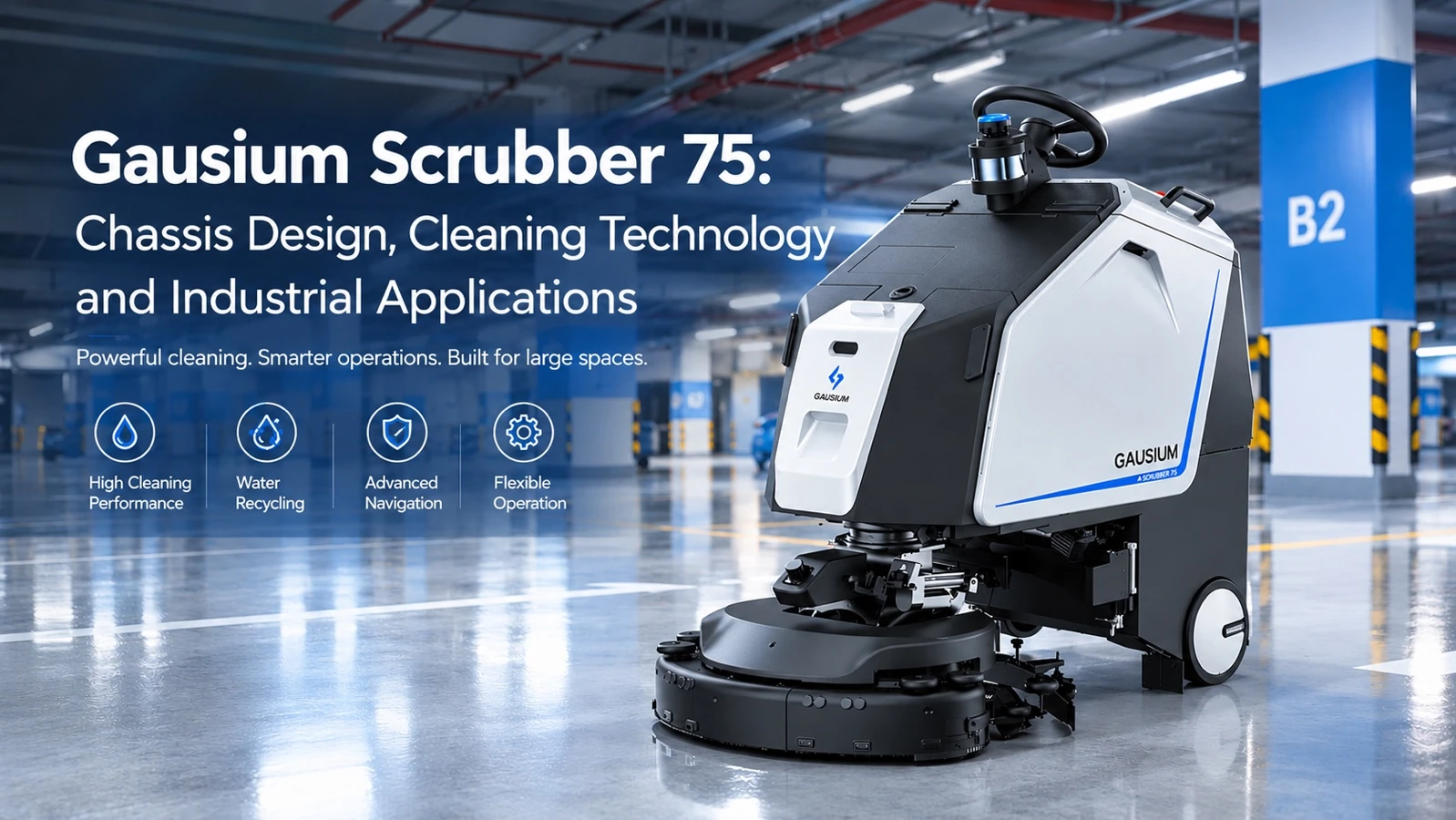
Cleaning a large warehouse, distribution centre or underground car park is not simply a matter of covering more floor space. Operators must remove stubborn dirt, navigate tight turns, manage water consumption and keep the machine working across long shifts—all while maintaining consistent cleaning results.
The Gausium Scrubber 75 autonomous industrial floor scrubber is designed around these challenges. With a 750 mm cleaning width, a 400 kg machine weight, a rotating scrub deck and an integrated water-recycling system, it combines mechanical cleaning performance with features intended to support large-scale floor maintenance.
But what do these design choices mean in practice? Let’s look at how the Scrubber 75’s chassis, cleaning system and operational features work together—and what facility managers should consider when evaluating an industrial floor cleaning robot.
1. Chassis Design: Built for Demanding Industrial Floors
The Scrubber 75 weighs approximately 400 kg. Rather than treating this as just a specification, it is useful to understand how machine weight relates to the cleaning task.
Effective floor scrubbing depends on the interaction between the brush, the floor surface, the cleaning solution and the pressure applied by the scrubbing mechanism. The Scrubber 75 specifies a brush pressure of 45 kg, helping its cleaning system work on the heavy soil and traffic marks commonly encountered in industrial environments.
This can be relevant in locations such as:
- Distribution centres with frequent forklift traffic
- Warehouses with long, heavily used aisles
- Underground car parks with tyre marks and accumulated dirt
- Manufacturing facilities with demanding floor-maintenance requirements
The machine’s size and weight also make site assessment important. Its published minimum passage width is 1,400 mm for general use and 1,800 mm in underground garages, while its minimum U-turn width is 2,000 mm.
Before selecting an autonomous floor scrubber, measure the narrowest aisle, the tightest turning area and any ramps along the proposed cleaning route. These practical constraints help determine whether a machine can operate efficiently within the available space.
2. A 750 mm Scrub Deck Designed to Reach Corners
Cleaning width affects how much floor a machine can cover in each pass. The Scrubber 75 has a 750 mm cleaning width and a published theoretical maximum cleaning efficiency of 3,000 m²/h.
For operational planning, however, Gausium also publishes a practical efficiency range of 700–1,400 m²/h. Actual results depend on the site layout, obstacles, cleaning conditions and operating configuration, so the practical range is the more useful starting point when estimating cleaning time.
A particularly notable feature is the 270° rotational scrub deck, which is designed to reach into 90° corners.
With a conventional fixed scrub deck, the machine may not be able to clean directly into every corner or along every awkward boundary. This can leave areas requiring additional attention from a manual cleaning team.
The Scrubber 75’s rotating deck is designed to address this limitation by extending its cleaning reach into corners. In environments with numerous parking bays, columns and junctions, this capability may help reduce missed areas and the need for follow-up cleaning.
Where the machine is configured with roller brushes, sweeping and scrubbing can also be combined in the same pass, allowing loose debris to be collected rather than simply pushed ahead of the cleaning process.
What this means for your facility: If your site has extensive hard flooring, frequent corners or recurring manual touch-up work, assess the scrub deck’s reach during a site demonstration rather than relying on cleaning-width figures alone.
3. Water Recycling: Supporting Longer Cleaning Operations
Water management is a major consideration for large-floor cleaning. A machine may have sufficient battery capacity to continue working, yet still need to stop when its clean-water tank runs low or its wastewater tank fills up.
The Scrubber 75 carries:
- 75 L clean-water tank
- 50 L wastewater tank
- Integrated multi-stage water filtration and recycling system
According to Gausium, the water-recycling system can reduce fresh-water consumption by approximately 80%. This is a manufacturer-stated figure, and the actual reduction should be confirmed against the relevant test conditions and site requirements.
The potential operational benefit is straightforward: recovering and reusing water can reduce dependence on fresh-water refills during cleaning operations.
For facilities with long cleaning routes or water points located far from the working area, fewer interruptions may help improve daily cleaning efficiency. The actual benefit will depend on the cleaning programme, floor conditions, water quality and maintenance practices.
How the water-management system fits into the cleaning process
During operation, the machine applies cleaning water as part of the scrubbing process and recovers wastewater for collection and treatment within its water-management system. The integrated filtration and recycling arrangement is designed to make better use of available water.
For facility managers, the important question is not just tank capacity. It is how often the machine needs to stop, how water is managed throughout the shift and whether the cleaning route can be completed within the available operating window.
4. Cleaning Oily Floors with a Dedicated Cleaning Mode
Industrial floors can accumulate different types of contamination. Dust and loose debris present one challenge, while oil and greasy deposits may require a different cleaning approach.
The Scrubber 75 includes an Oil Cleaning Mode that works with a detergent kit for oil-related cleaning applications.
This feature may be relevant to automotive facilities, workshops, manufacturing environments and car parks where oil contamination is part of the routine cleaning requirement.
Not every site needs this mode, and cleaning results will depend on the type and severity of contamination, the floor material and the cleaning chemicals used. Before specifying the machine, identify the main soil types on your site and confirm the appropriate configuration with the supplier.
Choosing a floor cleaning machine based on the actual contamination profile is more reliable than selecting one on floor area alone.
5. Autonomous Cleaning with Manual Driving Capability
Automation is important, but industrial cleaning operations do not always follow a perfect schedule.
A cleaning route may need to be interrupted by a spill, an obstacle or a temporary change in site activity. The machine may also need to move between cleaning zones or be repositioned for maintenance.
The Scrubber 75 combines autonomous operation with a stand-on pedal and steering wheel for manual driving.
This gives operators an alternative way to move and control the machine when circumstances require it. Rather than relying entirely on a planned autonomous route, the machine can also support practical on-site handling and repositioning.
For facility managers, this flexibility is worth considering when evaluating how an autonomous cleaning machine will fit into existing workflows.
The most suitable solution is not necessarily the one with the longest feature list. It is the one that can perform its assigned cleaning tasks while fitting the operational realities of the site.
6. Navigation and Safety in Busy Environments
Large cleaning machines must navigate around people, vehicles, structures and other obstacles. Their sensing systems and visibility features are therefore important parts of the overall design.
Gausium describes more than 20 sensors distributed around the Scrubber 75.
The published sensing configuration for the 75 S includes 3D LiDAR, 2D LiDAR, a 3D camera, anti-collision sensing and anti-drop sensing. The 75 P adds millimetre-wave radar and is positioned for car-park applications.
The two versions should not be treated as identical configurations. When choosing between them, confirm which sensors and safety functions are included in the specific model offered for your market and application.
The machine also features flashing lights and headlights to help make its position visible to people nearby.
These features contribute to the overall navigation and operational-safety design, but they do not eliminate the need for site-specific risk assessment, appropriate route planning and safe operating procedures.
For environments with vehicle traffic, changing light conditions or complex layouts, discuss the site conditions with the supplier before deployment.
7. Automated Charging and Water Management Between Shifts
A successful autonomous cleaning solution needs to account for what happens after a cleaning route finishes.
The Scrubber 75 can be configured with an optional WS-02 workstation. According to the product documentation, the workstation supports automatic docking, charging, clean-water refilling and wastewater discharge.
For suitable installations, these functions can reduce the need for staff to manually move the machine to charging and water-service points after every shift.
A mobile water tank is also available as an alternative arrangement for sites where a suitable water supply or drainage connection is not available near the workstation.
Before choosing a workstation configuration, check the proposed docking location, water supply, drainage arrangements and available space. These installation details can affect the practicality of an automated cleaning workflow.
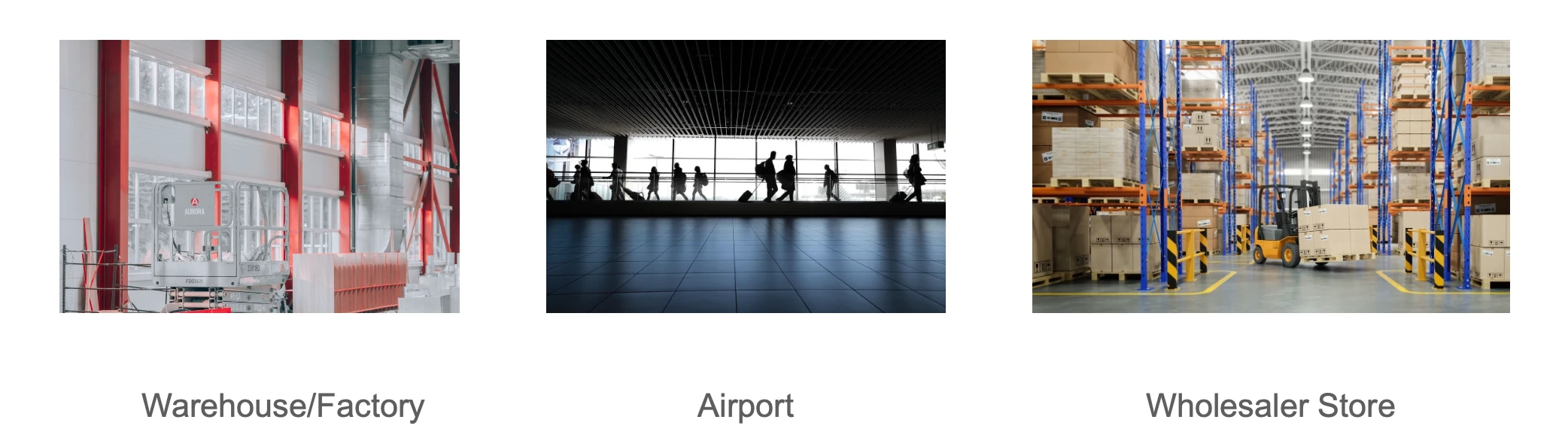
8. Where Is the Gausium Scrubber 75 Best Suited?
The Scrubber 75 is positioned for large hard-floor environments where cleaning coverage, soil removal and operational continuity are important.
Potential applications include:
- Underground car parks: large concrete areas, parking bays and recurring tyre marks.
- Warehouses and distribution centres: extensive floor areas and long cleaning routes.
- Manufacturing facilities: demanding floor-maintenance requirements and recurring industrial contamination.
- Shopping centres and retail facilities: large shared floor areas that require regular maintenance.
- Transport hubs: substantial hard-floor areas with ongoing pedestrian activity.
The published compatible surfaces include concrete, natural stone, PVC vinyl, PU, ceramic tile, epoxy and artificial marble and granite. Suitability should still be confirmed for the actual floor finish, surface condition and cleaning requirements at your site.
Is it suitable for your facility?
The Scrubber 75 may be worth evaluating if your facility has:
- A large area of hard flooring to maintain
- Recurring dirt or traffic marks that require mechanical scrubbing
- Sufficient aisle and turning space for a large machine
- A need to manage water consumption and cleaning interruptions
- A suitable operating environment for autonomous cleaning
It may be less suitable where access is restricted, floor areas are divided into many small rooms or the available turning space falls below the machine’s requirements.
A site assessment is the best way to establish whether its dimensions, cleaning system and operating configuration match your needs.
9. Key Specifications at a Glance
| Specification | Gausium Scrubber 75 |
|---|---|
| Variants | 75 S and 75 P |
| Cleaning width | 750 mm |
| Scrub deck | 270° rotational |
| Brush pressure | 45 kg |
| Theoretical cleaning efficiency | Up to 3,000 m²/h |
| Published practical efficiency | 700–1,400 m²/h |
| Clean-water tank | 75 L |
| Wastewater tank | 50 L |
| Water management | Multi-stage filtration and water recycling |
| Battery | 200 Ah lithium iron phosphate, 24 VDC |
| Approximate runtime | 4–6 hours |
| Approximate charging time | 5 hours |
| Dimensions | 1,370 × 962 × 1,417 mm |
| Net weight | 400 kg |
| Minimum passage width | 1,400 mm general; 1,800 mm underground garage |
| Minimum U-turn width | 2,000 mm |
| Manual operation | Stand-on pedal and steering wheel |
| Optional automated servicing | WS-02 workstation; mobile water tank available |
Specifications are based on Gausium’s published product information. Runtime, cleaning efficiency and water savings can vary with operating conditions and configuration. Confirm current specifications and the configuration available in your market before purchase.
10. How to Evaluate an Industrial Floor Cleaning Robot
When comparing autonomous floor scrubbers, it is easy to focus on cleaning speed or automation alone. A more useful evaluation considers the complete cleaning operation.
Start with your floor and cleaning requirements. Identify the surface material, typical soil types, total area and frequency of cleaning.
Check the physical layout. Measure aisle widths, turning spaces, ramps, doorways and access points before selecting a machine.
Assess water and charging arrangements. Consider where the machine will dock, how clean water will be supplied and where wastewater will be discharged.
Review the operating workflow. Determine how the machine will handle interruptions, manual repositioning, maintenance and changing site conditions.
Validate performance on site. Where possible, arrange a demonstration using representative floor conditions and agree on the performance measures that matter to your operation.
The objective is not simply to purchase an autonomous machine. It is to select a cleaning solution that matches your facility, can be integrated into your workflow and delivers measurable operational value.
Explore the Gausium Scrubber 75 for Your Facility
Looking for an autonomous industrial floor scrubber for a warehouse, distribution centre, manufacturing facility or underground car park?
The Gausium Scrubber 75 combines a wide cleaning path, a rotating scrub deck, water-recycling technology and optional automated servicing to support demanding large-floor cleaning applications.
Contact our team to discuss your site requirements. Share your floor area, surface type, cleaning challenges, aisle dimensions and available water and drainage facilities. We can help you assess the machine’s suitability, review configuration options and identify the next steps for a site evaluation or product demonstration.