
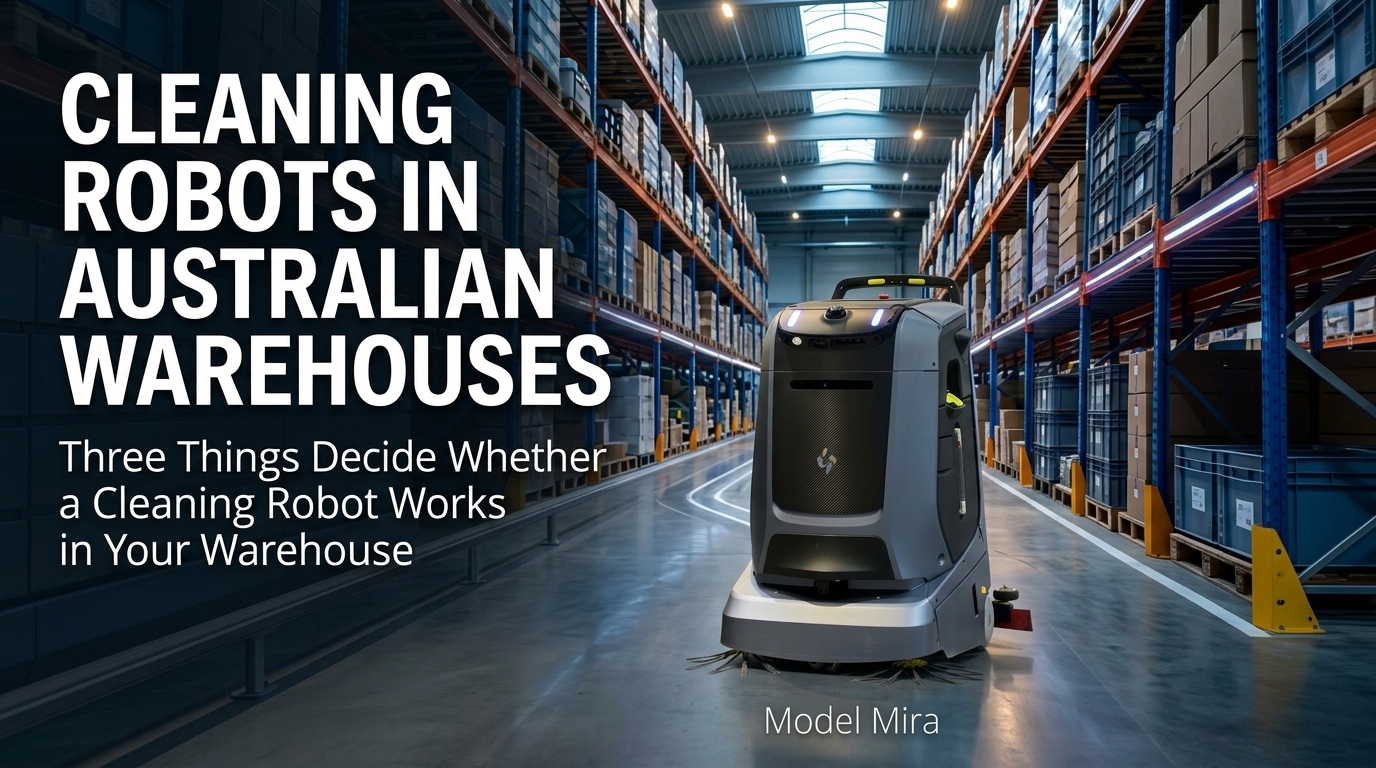
Walk a distribution centre at ten at night and it looks like the easiest cleaning job in the country. Forty thousand square metres of sealed concrete. Runs so straight you could land a plane on them. No carpet, no desks, nobody in the way.
Then you spot the three pallets someone left at the end of aisle 14 for the morning pick.
That’s the whole story, honestly. Warehouses are where cleaning robots should shine, and they’re also where we see deployments quietly die. Gausium’s own industrial guidance names the reason in five words: what matters is route ownership, not scrub width.
The racking isn’t the problem
Everyone assumes it is. It almost never is.
Australian warehouse aisles come in three flavours. Wide aisle runs 3 to 4 metres for standard forklifts and pallet jacks. Narrow aisle sits at 2.4 to 3 metres, which is turret truck and order picker territory. Very narrow aisle, the stuff built for high-reach equipment, gets down to 1.5 to 2 metres.
Now put a Gausium Marvel next to those numbers. It needs 850 millimetres of aisle and 1,300 millimetres to turn around. Even the tightest VNA run clears both with room to spare.
So the machine fits. Fine. The real question is whether the map fits, and that’s a different animal entirely.
Robots drive a warehouse off a stored map. And a warehouse is the one building type on earth whose floor plan changes on purpose. Pallets get staged in the aisle for a morning pick. A bay gets re-racked over a long weekend. November brings in seasonal stock that sits on the floor until February.
So before you look at a single spec sheet, answer this: how often does your layout actually move? If the racking is bolted down and the aisles get kept clear, you’ve got a site. If the honest answer is “depends on the week”, you’ve got a project. Still solvable. But it starts with floor discipline, not with a purchase order.
You’re probably judging it on the wrong mode
Second thing people get wrong: they buy a scrubber for a dust job.
Think about what’s actually on your floor at the end of a shift. Shrink wrap. Strapping. Tape. Timber splinters off the pallets. Paper, foil, and a fine grey film of general particulate over everything. It’s dry soil, nearly all of it.
i-team ANZ’s guidance for warehouse floors puts daily dry sweeping first for exactly that reason, and reckons it lifts up to 80% of dry particulate soils. Machine scrubbing comes weekly. Spills get dealt with on the spot. They also note regular cleaning can cut airborne dust by up to 70%.
Keep that ordering in mind, because it lines up with something in the spec sheets that most buyers skip straight past.
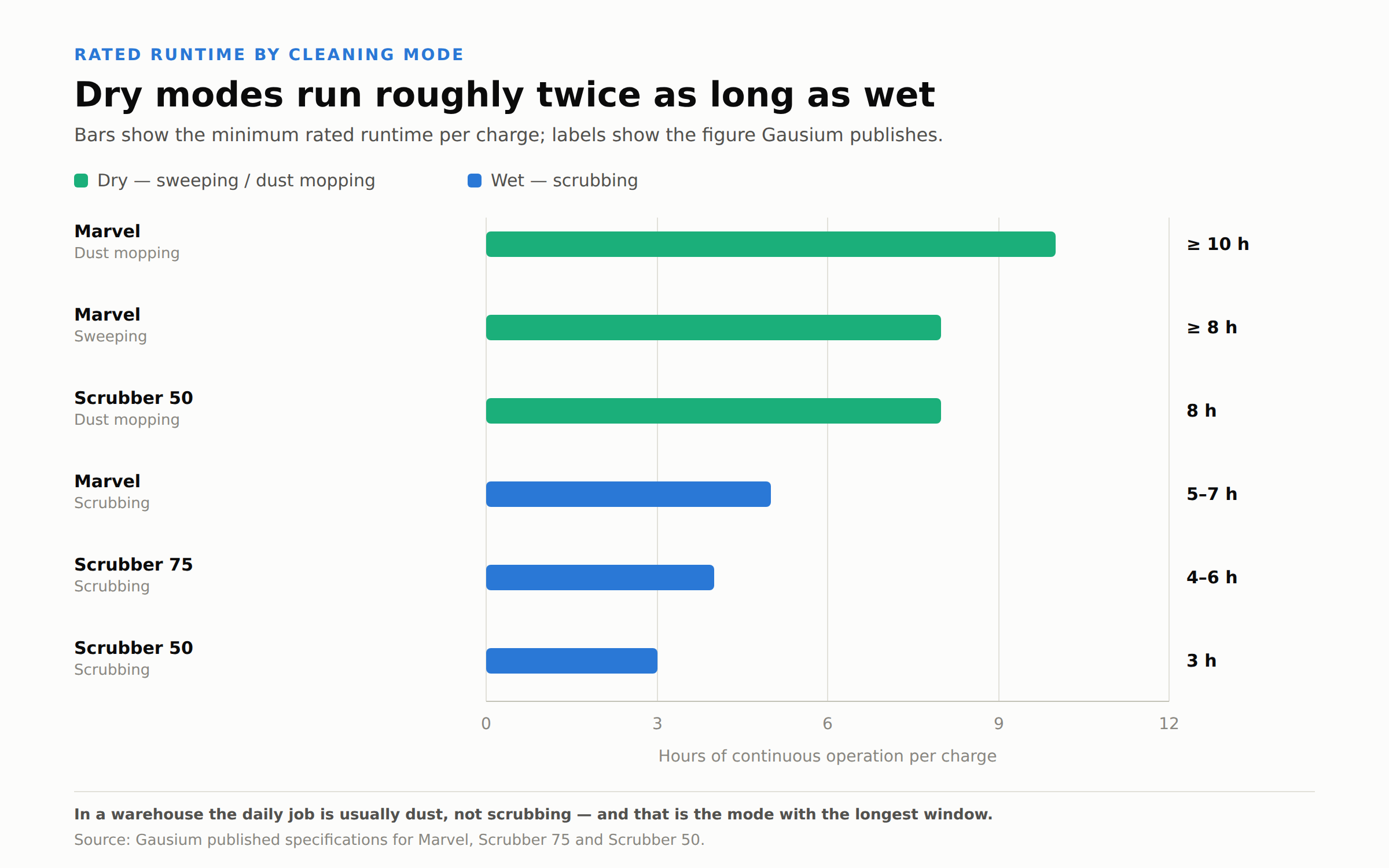
Rated runtime per charge, from Gausium’s published specifications.
A Marvel gets you 5 to 7 hours of scrubbing on a charge. Switch it to sweeping and that becomes 8 hours or more. Dust mopping, 10 hours or more. The pattern repeats down the range: a Scrubber 50 does 3 hours of scrubbing, or 8 hours of dust mopping.
The dry path is wider too. On the Marvel it’s 840 millimetres sweeping against 600 scrubbing.
Read that back slowly. The job your warehouse genuinely needs every night is the job the machine can run nearly twice as long at, over a wider path, without stopping to charge. If you’ve been sizing these things up purely as scrubbers, you’ve been looking at their worst numbers the whole time.
Something changes in December
There’s a compliance clock ticking on the dust question, though it’s worth being careful about what it does and doesn’t say.
From 1 December 2026, Safe Work Australia’s Workplace Exposure Limits replace the current Workplace Exposure Standards, adopted across the Commonwealth, states and territories. The rename is deliberate. “Limits” makes it plain these are numbers you don’t go over.
Now the caveat, because you’ll get asked. This is a framework change, not a new dust figure aimed at warehouses. Respirable crystalline silica in particular stays on the old standard until more impact analysis lands.
What it does mean: from December, how you manage airborne contaminants gets looked at harder. And the cheapest lever anyone has on floor-generated dust is a consistent nightly dry sweep. Which, going back to the chart, is the mode with the longest runtime on the machine.
Can it finish before the forklifts come back?
Here’s where warehouses differ from every other site we look at. Throughput per hour barely matters. What matters is the gap between the last pick and the first forklift, and whether the machine can cover your floor inside it.
Gausium publishes a theoretical rate for the Marvel but no practical one. We’re not going to quote you the theoretical figure, because no machine on earth hits it. Instead, borrow the haircut Gausium publishes on its own Scrubber 75, where real-world efficiency lands at 23 to 47% of theoretical. Apply that same band to the Marvel in sweeping mode and you get a planning range of roughly 1,000 to 2,000 m²/h. Call the midpoint 1,500 and work from there until you’ve measured your own site.
On that basis:
| Floor area | Sweep time at ~1,500 m²/h | Fits an 8-hour charge? |
|---|---|---|
| 5,000 m² | 3.4 h | Comfortably |
| 10,000 m² | 6.7 h | Yes |
| 15,000 m² | 10.1 h | No. Mid-shift charge, or a second machine |
| 20,000 m² | 13.5 h | No. Two machines, or zone the site |
Run the same areas in scrubbing mode, where the planning midpoint is closer to 1,050 m²/h against a 5 to 7 hour charge, and you only clear a single charge up to about 5,000 m².
Which is the arithmetic behind that tiered program. Sweep the whole floor nightly. Scrub one zone at a time, weekly.
What actually goes wrong
Five failure modes, roughly in the order they show up.
The map goes stale. Layout drifts, the robot starts refusing routes, and inside a fortnight someone’s parked it against a wall and gone back to the old way. This one kills more deployments than everything else combined.
Stock ends up on the floor. A robot that meets a pallet where its map says open aisle will work around it, slowly, over and over. Or it’ll just stop. Aisle discipline isn’t a nice-to-have here, it’s a precondition.
Forklifts and robots share the space. Detection isn’t really the issue. Predictability is. You want the machine to behave the same way every time a forklift comes round the corner, so the driver stops thinking about it. Gausium’s answer is 3D LiDAR paired with vision that identifies people and vehicles and adjusts path. Test it on your dock, at your shift change, not in a showroom.
The dock. Wet, gritty, busiest part of the building, and usually the filthiest. Plan to keep it manual or schedule it on its own.
Oil and grease. If that’s your actual problem rather than dust, a dry sweeper is the wrong tool. Gausium says as much about its own Beetle: not the right fit when the main issue is oil, spills or embedded soil.
So is your site one of them?
Rough test. Does the racking layout hold still for months at a stretch? Do the aisles genuinely stay clear of staged stock, or only in theory? Is the floor sealed concrete or epoxy and in decent repair? Have you got four to six hours of clear floor to play with? And is the shift you’d be displacing carrying afternoon or night penalty rates?
Three or more yeses and it’s worth a proper look at the site.
If the first two are a no, start there. A robot won’t create floor discipline for you. It’ll just make it very obvious you don’t have any.
Want the numbers for your site?
Send through your floor area, racking layout, shift pattern, and what’s genuinely sitting on the floor at 10pm. We’ll run the window calculation above against your building and tell you if the answer’s no.
Sources
Gausium published specifications: Marvel, Scrubber 75, Scrubber 50 · Gausium, industrial floor scrubbers guide · i-team ANZ, warehouse floor cleaning · Total Racking, Australian warehouse aisle widths · Safe Work Australia, new Workplace Exposure Limits from 1 December 2026